


How to Read Wood Grain Direction Before You Cut to Avoid Tear-Out
You run a hand plane across the board and the surface tears up instead of smoothing out. You rout an edge and the bit leaves a ragged, chipped line instead of a clean profile. You make a pass with the jointer and the surface looks worse than before the machine touched it.
Reading wood grain direction before cutting, planing, or routing is the skill that determines whether a tool produces a clean result or destroys the surface. Every tool that contacts wood follows the grain or works against it, and the difference between those two situations shows immediately in the surface quality.
Why Does Grain Direction Matter So Much in Woodworking?
Reading wood grain direction correctly allows every cutting tool to work with the fiber structure of the wood instead of lifting and tearing it. Wood fibers run along the length of a board and interlock in a direction that either supports or resists the cutting edge depending on which way the tool moves.
When a plane iron, router bit, or jointer knife cuts in the direction the grain rises, the fibers ahead of the cut are supported from below and slice cleanly. When the tool cuts against the grain direction, the fibers ahead of the cut have no support and lift out of the surface, producing tear-out that ranges from a slightly rough texture to deep chunks pulled from the face.
The Basics of Wood Fiber Orientation
Think of wood grain as a series of interlocking wedges running along the length of the board. On flat-sawn lumber, these wedges are most visible on the long edge of the board where the end grain meets the face. The direction those wedges point, either rising toward you or diving away from you as you look along the board, determines the correct cutting direction.
The correct feed direction for any cutting tool is the one where the tool cuts downward into the wedge, not upward against it. A tool moving in the correct direction engages the fibers from above and slices them cleanly. A tool moving in the wrong direction engages them from the side or below and peels them away from the surface.
Why Some Boards Tear Out in Both Directions
Interlocked or wavy grain, which is common in tropical hardwoods and some domestic species like elm and cherry, changes fiber direction multiple times across the length of a single board. Reading wood grain direction on these species is more complex because a direction that cuts cleanly in one section of the board tears out in the next.
For these materials, taking lighter passes with sharper tools, wetting the surface slightly before hand planing, or using scrapers instead of planes produces better results than trying to find a single correct direction.
How to Read Wood Grain Direction Before Cutting
Use the Long Edge of the Board
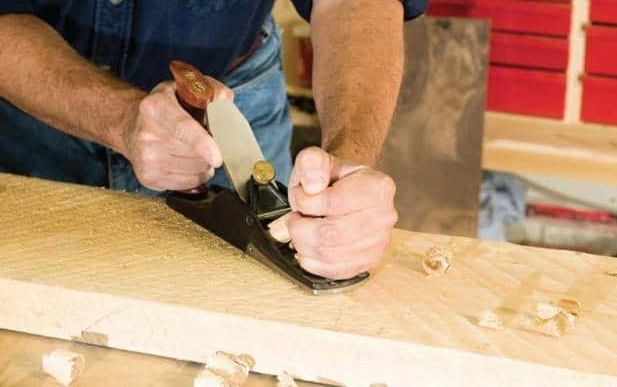
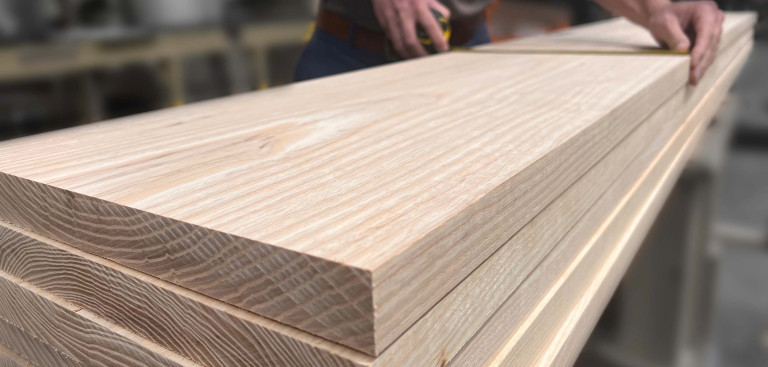
The clearest way to read grain direction is to look at the long edge of the board at eye level. The lines running along the edge show the angle at which the grain rises or descends along the length of the board.
If the lines on the edge angle upward from left to right, feed the tool from right to left to cut with the grain. If the lines angle upward from right to left, feed from left to right. The tool should always be moving in the direction that cuts down the slope of the grain, not up it.
This method works reliably for face grain operations including hand planing, jointing, and routing along the face of a board. Practice reading grain direction on a piece of scrap before committing the technique to a project board.
Read the Face Grain Pattern
The grain pattern on the face of a board also indicates fiber direction, though it is less immediately readable than the edge method. On flat-sawn lumber, the cathedral grain pattern, which resembles arch shapes running along the face, narrows toward one end of the board. The arches narrow in the direction the grain is rising, which means the correct planing direction is toward the narrow end of the arch pattern.
This applies primarily to hand planing and jointing where feed direction is fully controlled. For router operations and other power tool passes, the long-edge method gives a clearer directional reference.
Check the End Grain for Deeper Understanding
End grain reveals the full cross-section of the wood fiber structure and is the most accurate reference for understanding how grain behaves in the rest of the board. Reading wood grain direction from the end gives information about quartersawn vs flat-sawn orientation, ray patterns, and the angle of the growth rings, all of which affect how the board machines, moves with humidity changes, and accepts finish.
For practical cutting decisions, end grain confirms what the long-edge method shows and adds context for materials with complex or irregular fiber structure.
Use a Sharp Pencil or Your Thumbnail
A quick practical test for grain direction on any board is to lightly scratch the surface with a sharp pencil or your thumbnail in both directions along the length. The direction that produces a smooth, clean scratch is with the grain. The direction that catches or feels rough is against the grain.
This test works across species and takes less than ten seconds per board. It is particularly useful on figured or irregular grain where visual reading gives ambiguous results.
How Grain Direction Affects Specific Tools
Hand Planes and Grain Direction
Hand planing is where reading wood grain direction matters most, because an incorrect feed direction on a sharp, well-set plane tears the surface badly enough that correcting the damage requires removing significant material.
Always plane with the grain, moving in the direction that cuts downward into the fiber rather than lifting it. On boards with a straight grain pattern this is straightforward. On figured or reversing grain, reduce the cutting angle by adding a back bevel to the iron or use a cabinet scraper instead of a plane for the affected sections.
Routers and Grain Direction
A router bit spinning at high speed tears out end grain and cross grain far more aggressively than a hand tool. Reading wood grain direction before routing determines both the feed direction and the climb cutting risk that comes from incorrect direction changes during a pass.
For edge profiling on solid wood, routing in the correct direction means the bit is cutting downward into the face grain. On corners where the grain direction changes, slowing the feed rate slightly and ensuring the bit is sharp prevents tear-out at the transition point.
Jointers and Grain Direction
The jointer is one of the most sensitive tools to incorrect grain direction because the rotating cutterhead removes material very aggressively and the results are immediately visible on the full length of the board.
Feed the board with the grain direction matching the cutterhead rotation, meaning the grain should be rising in the direction of the feed so the knives cut downward into it rather than lifting the fibers from below. If a pass tears out, flip the board end for end and joint in the opposite direction before attempting the next pass.
Reading Grain Direction on Different Wood Species
Not every species shows grain direction equally clearly. Straight-grained species like poplar, ash, and quartersawn oak make reading wood grain direction easy because the lines on the face and edge run parallel and consistently along the board length. The same species differences that affect cutting direction also affect how evenly these woods absorb stain, which is covered in why wood stain goes blotchy and how to get an even finish.
Figured species like curly maple, birds-eye maple, and crotch pieces have interlocked grain that defies consistent directional reading. For these materials, sharp tools with a high cutting angle, very light passes, and finishing with a scraper rather than a plane produces better results than attempting to optimize feed direction alone.
Highly resinous softwoods like pine and cedar also present grain direction challenges because pitch pockets and knots create local reversals in fiber orientation that are difficult to anticipate from surface reading alone.
👉 Book a demo today and see how Woodshop Master helps your shop grow without limits.
FAQ: Table Saw Cut Accuracy
Why does my board tear out even when I think I am planing with the grain?
The most common reason is that the grain direction changes partway along the board, which happens in flat-sawn lumber where the growth rings run at an angle across the width. Check the edge grain at several points along the board length rather than reading it at one end and assuming the direction is consistent throughout.
Does grain direction matter when using a table saw or circular saw?
Less so than with hand tools and routers, because saw blades cut through fibers rather than shearing them at a low angle. Grain direction matters more for the side of the material that faces up or down during cutting, which affects which face shows tear-out, as covered in the circular saw plywood guide. For rip cuts with the grain, feed direction follows the board length and is not a variable.
How do I handle a board that tears out in both directions?
Use a card scraper instead of a plane for the final smoothing passes. Scrapers work by flexing a burr edge across the surface at a very low cutting angle, which shears fibers without lifting them regardless of direction. A sharp scraper on difficult grain produces a surface that a hand plane cannot match.
Does grain direction affect wood finishing?
Yes. End grain and cross grain absorb stain and finish at different rates than face grain, which is one of the causes of blotchy stain on certain species. Reading wood grain direction also matters when applying oil finishes by hand, since wiping against the grain can raise small fibers that dry into a rough texture under the finish. Grain direction also determines which face of a plywood sheet tears out under a saw blade, which is covered in detail in why your circular saw keeps blowing out plywood edges.
Is quartersawn lumber easier to work than flat-sawn for grain direction?
Generally yes. Quartersawn lumber has growth rings running perpendicular to the face, which produces a consistent ray fleck pattern and a grain direction that is more stable and predictable for hand tool work. It is also more dimensionally stable with humidity changes. The tradeoff is higher cost and more limited availability at most home centers. POST: The mistake starts before the first cut 👇 Link in the comments. Linkedin: #WoodworkingTips #Craftsmanship #WorkshopSkills

